
Chapter 8 of the CA Arts Education Framework outlines an instructional design strategy to create co-equal arts integrated learning experiences. The strategy includes
- Thoughtful selection of the corresponding standards in each content area
- Clearly identified learning goals for each content area
- Assessment opportunities identified for each learning goals
- Selection of an effective integration approach such as multidisciplinary, interdisciplinary, transdisciplinary, etc.
Resources for Group or Independent Study
This slide deck is customizable for use when studying the concepts outlined in Chapter 8: Transcending Disciplinary Boundaries–Arts Integration. Topics include how the California Arts Education Framework defines arts integration, the benefits of arts integration, how to approach the design of integrated instruction and many prompts for discussion. The slide deck should be used in short chunks with ample time for discussion and planning.
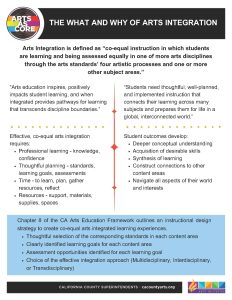
This one page document summarizes the “what” and “why” that guides the approach to arts integration that is articulated in the Arts Education Framework.
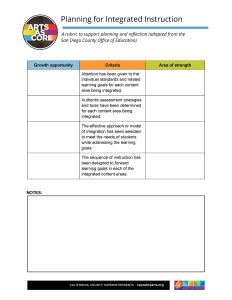
This simple rubric supports thinking about how to approach planning for integrated instruction or strengthening an existing lesson sequence.
Sample Integrated Learning Sequences for Classrooms
Teachers are encouraged to personalize these learning sequences to support Social Emotional Learning, as the arts and sciences provide authentic opportunities to:
- Let your students get to know you and each other
- Get to know your students and build positive relationships
- Check in on students and let them know that you care about each of them
- Give students as many opportunities as possible to connect and get to know each other
- Allow for choice and creativity as students build and demonstrate competency and expertise
Grade 4
Grade 8
High School
- Music and Computer Science Integrated Learning Sequences Lesson Plan
Other Resources
- Teaching Visual Arts in Connection with History/Social Studies is a professional learning module that provides a model for integrating Visual Arts and History Social Science, and provides integrated units for teaching Visual Art and History/Social Science standards in grades 2, 3, 5, 6, 8, and 10.
- Media Arts for Elementary Classrooms is a professional learning module that features the 2019 California Arts Standards for media arts and Los Angeles County Office of Education’s Technology Enhanced Arts Learning (TEAL). It provides a blended model of online and virtual professional development. Outstanding industry partners provided foundational skills and instruction along with TEAL experts.
- Distance Learning Units of Study designed by San Diego County Office of Education focus on grade-level essential learnings in each content area. These units integrate content and provide flexibility and choice and can be used for distance and in person learning.


