

Synopsis
Moorpark High School’s Musical Show Production and Advanced Musical Theater allow students to participate in all elements of theater production while taking on leadership roles. They have complete creative control and a sense of ownership of a production that they write, produce, advertise, choreograph, direct, and perform. Students can blossom as leaders and show off their creative strengths in a number of areas. One student summed up our program best when she said, “In this pro9gram, you learn important life skills, such as leadership, perseverance, and teamwork, since you’re all working together for the same goal.”
This is a story about . . .
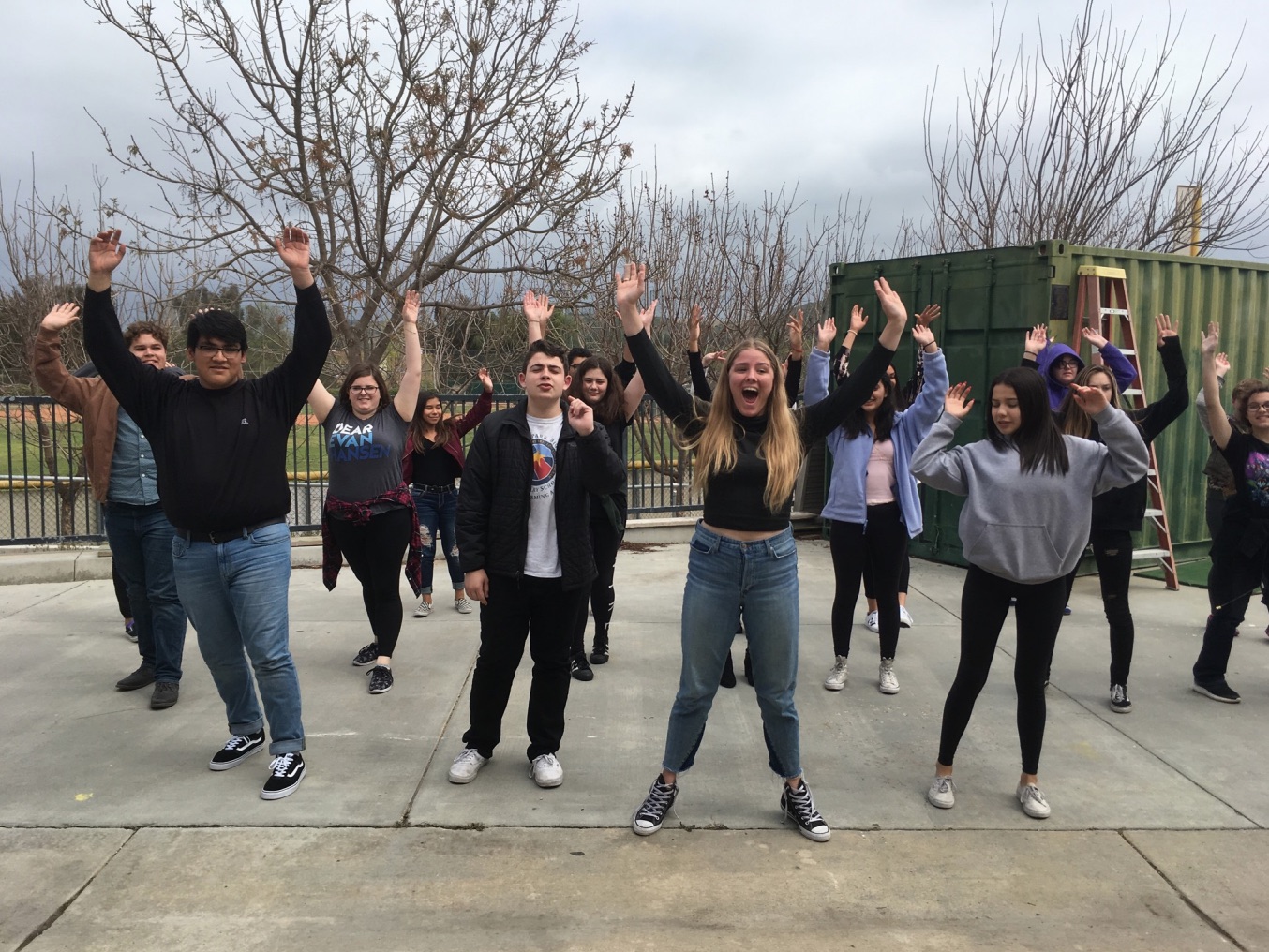
Students having a creative outlet that is entirely in their own control.
It’s important because . . .
It allows students to take control of their education and learn real-life skills that will help them in the fields of music, dance, theater, and art as well as in any career path they choose.
Key components to the successful implementation of arts education at Moorpark High School are:
- A hugely important element to our success has been teamwork. The Musical Show Production / Choir teacher and I work hand in hand and always support each other to ensure that every performance is a success. As the CCSESA Promising or Best Practice Spotlight program grew, we brought in more people with whom we work quite well, and who also have the best interest of the students at heart.
- It is also important to allow the students to be creative. One of my students stated that these classes are “a great outlet for creativity.” In order to pass the reins over to our students, we have to trust them with this creative control, so we need to establish a good rapport with our kids and establish strong guidelines.
- Finally, and perhaps most importantly, we need to make sure that our kids feel loved and welcomed. A sense of community is necessary for students to feel safe enough to perform onstage and perform as leaders. One of my students, who was extremely shy last year, said this year that our theater program “gives people an opportunity to break out of their shell.” Our students need to rely on and work with each other daily in order to put on a successful show, so it is important that they get along, and while every drama program has a bit of, well, drama, all of my students agreed wholeheartedly when one stated that, “you gain a really great group of friends because
everyone is kind of like family.”

Time frame
Musical Show Production began at Moorpark High in 1995. Since then, the program has expanded greatly. Our program now includes Advanced Musical Theater, for students who wish to continue in their academic knowledge of theater as well as progress their creative strengths. Within the past few years, these classes have provided the basis for a new pathway on campus: musical theater. Last year, we added a stage production class to this pathway, too. These classes are also the basis for the Spring Musical on campus, which allows our choir, theater, and orchestra pathways to work together for a large scale production. Last year, the school was named a Gold Ribbon school, in part because of these three pathways, which were featured prominently in both the school presentation and the written application. We were then honored to be named an Exemplary School by the California Department of Education for our performing arts program.
Setting
Moorpark is both suburban and rural. Located towards the East end of Ventura County, Moorpark includes farmland, orchards, and housing developments. It is a suburb of both Los Angeles and Oxnard. It is important to note that 16.5% of our district’s students are English Language Learners and 34.1% of our district’s students are on the free and reduced lunch program.
Moorpark Unified School District is relatively small, with five elementary schools, one K-8 school, two middle schools, one high school, and one alternate high school. We are located amidst farmland in a valey surrounded by the Santa Susana mountains. There are several affluent neighborhoods in Moorpark, as well as “old town” Moorpark, which has some of the town’s oldest business and houses. Our community is highly involved in the local schools, with several local business owners as members of the School Board. Parents, students, and community members all support the arts here at Moorpark High School by attending and advertising our shows.

Key Characters
Who’s important to the story—a visionary administrator, a group of teacher leaders, an active parent organization, a visual and performing arts coordinator?
A strong team is incredibly important to the success of this program. We need to leave our egos at the door and always try to do what is best for our kids. When we put on a musical in the Spring, I work alongside the choir teacher, orchestra teacher, and stagecraft teacher. We always try to come to a consensus before we make choices, and we help each other out as much as we can. For example, the choir teacher and I also come in on weekends and afternoons to help build sets. In fact, it has been important that we have strong buy-in from administration and other staff members, too. Occasionally, we have other teachers join us to build sets or lend us props, and many staff members come to see our shows, in addition to advertising them in their classes. After we put on Phantom of the Opera two years ago, we also started to get even more support from administration, and they have trusted us to put on fantastic shows, which is part of the reason they applied for Gold Ribbon School and Exemplary School.
Introduce us to your protagonist. Help us imagine him or her. Better yet, help us care.
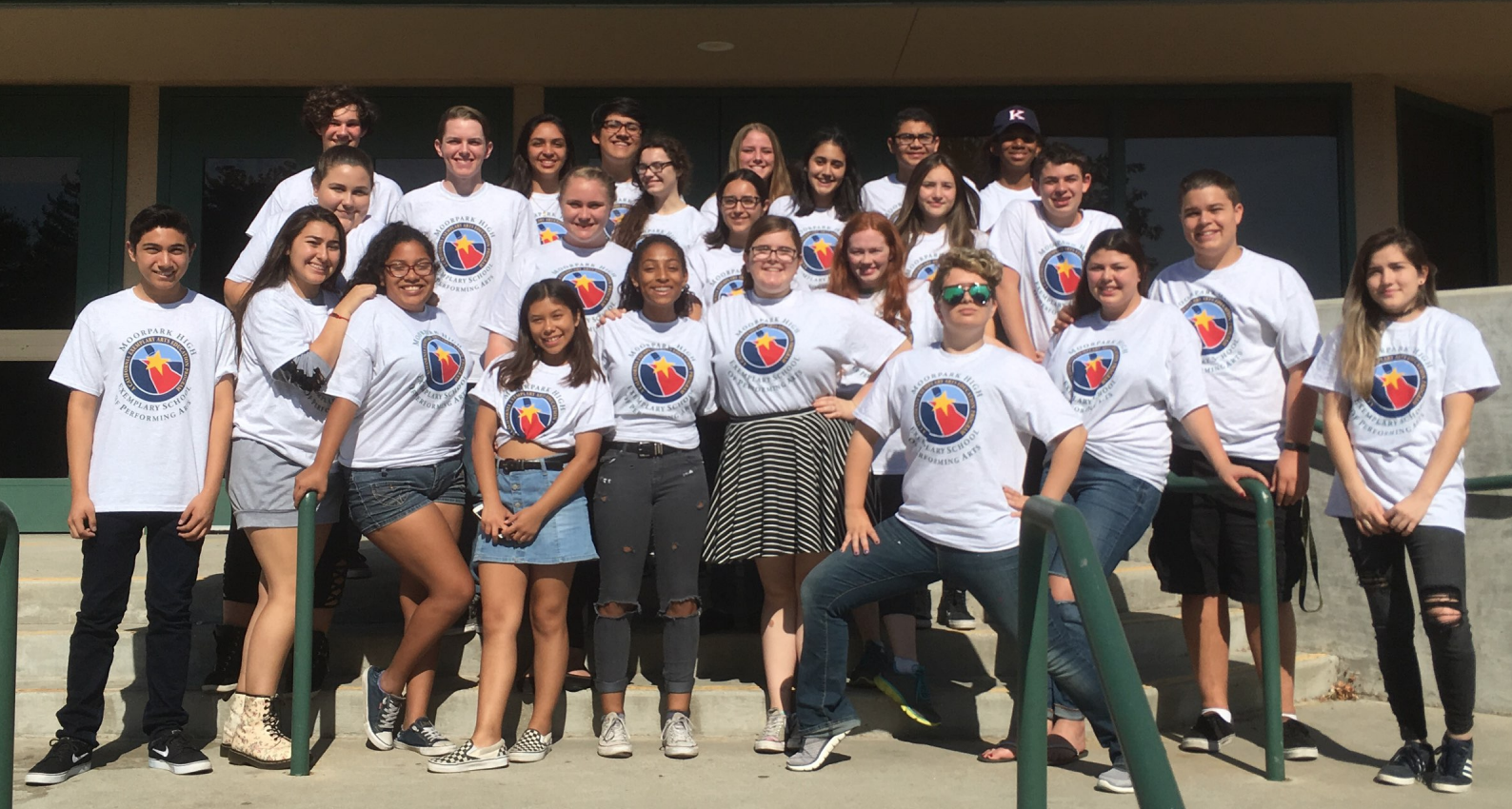
Ray Hebel is the heart of our program. He established the very first Musical Show Production class back when I was still in elementary school, and he has kept it going for years. As a professional Elvis impersonator, one would think that he would have the ego of a diva, but he really is always focused on the kids and puts them first. They call him “Dad” or “Papa Hebel,” and they truly love him like family. He is quite organized and always makes sure that we are on track and on time for every production. Ray Hebelm knows the common pitfalls and problems we must overcome, and he has helped to guide me ever since I started directing shows at
the school just over five years ago.
Plot
What happened that’s compelling? What’s the source of tension or catalyst for change?
Bringing me in to the program was honestly both a source of tension, at first, and also a catalyst for change.
Administration was looking to bring more life and a fresh perspective into our theater program, and when they thought that I was going to transfer to an arts magnet school, they asked me to start directing shows at the school, which is something I had never done, having only worked as a performer, never a director. Ray Hebel and I got along quite well, and I encouraged him to choose new shows, rather than the traditional ones he had been comfortable with. A couple of years later, there was tension when administration gave me Advanced Musical Theater, since Ray was concerned they were trying to squeeze him out, but we soon began to really rely on each other more than ever, and he is now so glad that we are both teachers in the program. We each have the other to help and support us and give advice. Eventually, he came to trust me enough to start pursuing much more ambitious productions, and we also started bringing morenew blood into our performances, both as teachers and as contractors.
What are the key indicators that provide promising or best practice examples?
The key indicators of the success of this program are performances, related lessons, and student buy-in. The class really starts with lessons that get students working with different elements of theater and getting out of their shells. I incorporate monologues, character creation, improvisation, research, music theory, acting
theories / techniques, levels of comedy, and theater vocabulary. While the focus of the class is students working together to put on a production, I think that it is important that they learn technique and other information that will help them if they remain in this field in college and beyond, which is why I raise the rigor and have true theatrical projects, quizzes, and assignments beyond the productions. It also helps to ensure that students take the class seriously. They certainly have passion, but to make it, they also need a strong work ethic. Another indicator is how effectively the students work in their assigned committees and leadership positions. Ultimately, that will determine how good their performances are.
Plot Key Areas
- Standards-based curriculum
- Arts Integration
- Professional development
for generalist and specialist
teachers - Programmatic oversight
- Assessment
- Community/partnership engagement
- Supports for English learners
- Strategic Planning
- Leadership
- Administrative support
- Use of Title I funding to
support school improvement - Parent and/or community
support - Other?
What is the evidence of success? Highlight as many as these key areas apply to your “plot”:
Evidence of our success has been standards-based curriculum, arts integration, assessment, strategic planning, leadership, and community support. In terms of learning standards, we actually use standards related to theater, dance, and music, since we are a musical theater program. It is important that the first class really get the students’ feet wet, and that the second course further their knowledge. Musical Show Production gets kids really excited about theater, and Advanced Musical Theater teaches them more about technique, growth, and effectiveness. We truly integrate many elements of art, since the students write the show, write the songs, choreograph the dances, and design and create their own sets. Since these are large-scale productions that students work on from the start of the semester onward, it is important that we plan strategically in order to bring all of the necessary elements together and get the show ready for performances. We need a long-term vision each year. We, as the teachers, need to lead the students by example and support them as
they become leaders in their own right. Finally, it is important to get the community out to our school to support the students in their productions. This year, more than ever, we have been trying to reach out to the community to get the support we need for our program.

Outcomes
Yes, students learn the standards that will help them, should they choose to remain in theater throughout college and into their careers. One student stated that he loved Musical Show Production and Advanced Musical Theater because, “it provides a new point of view to a career pathway that a lot of people don’t have the opportunity to explore.” However, and more importantly, students learn about a variety of arts, thus allowing them to explore their creativity, and they know what it means to be leaders and to truly work together as a team.
These are lessons that will help them no matter what they choose to do in life. The friendships they build and skills that they gain will benefit them in college and in the work force regardless of their chosen field of study or employment. Specifically, they learn time management, productive communication, critical thinking, and artistic/creative skills and also learn to compromise while also working toward a shared vision. The lasting impact on campus has been to grow our program and remind administration, students, and the community how important arts education is to the development of students as a whole. School is more than lessons in
fundamental skills; it is preparation for life.
Why It Matters
What’s the value of sharing this story? How does it relate to improved student learning? How does it relate to improved practices for implementation of arts education?
I hope that sharing this story helps people to see how arts education benefits students. It is not just a time for play or an easy A, but is, instead, truly a learning experience that helps them to grow as individuals. In terms of arts education, I think it is important to show how working together with other teachers in the arts can benefit everyone. If I did not have the strong team that I have, I know that my class could not be as successful as it has been. Sometimes we get into our own bubbles and stay trapped in our classrooms, but it is really important to work together and collaborate, especially since this helps students to learn the skills necessary in multiple fields of the arts. I also think that it is great to allow students to have some creative control, since school is often a lot of “do as I say” lessons. My kids are young adults, and I want them to be prepared to go forward as adults in the real world, so they need to learn to work as leaders and collaborators.


